MOUNTCASTLE'S COLUMN have Foundations... with MICRO PYRAMIDS
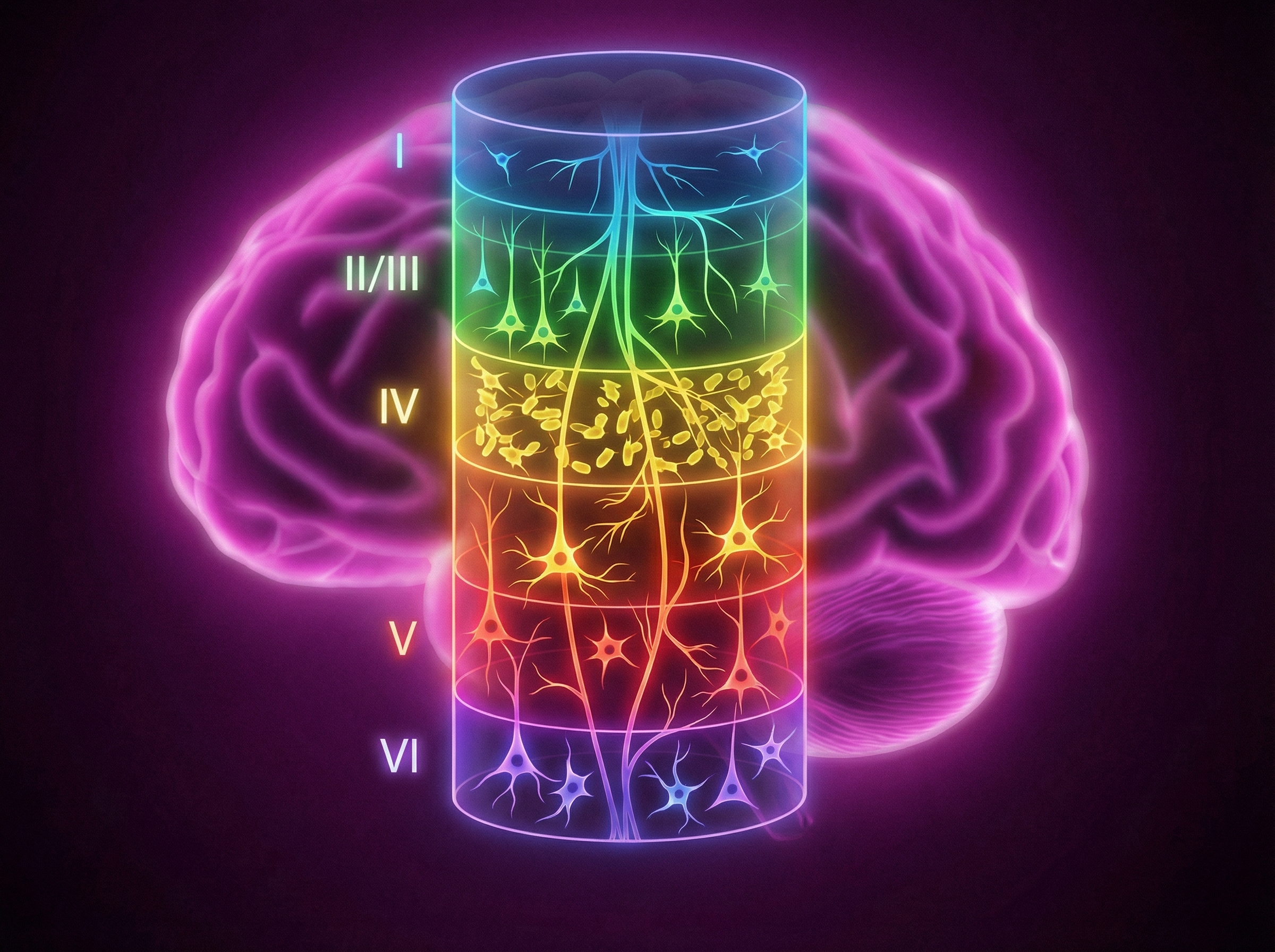
The cerebral cortex does not appear to be a random sheet of nervous tissue. Again and again, nature seems to repeat a vertical plan, a disciplined architecture, as if thought itself needs columns, layers, and living lines of ascent. Mountcastle's vision suggested that these cortical columns may be among the brain's most fundamental working units.
Across wide regions of cortex, one begins to see a repeated pattern, not exact in every detail, yet similar in intention. This idea was profound, because it suggested that brain function may arise not merely from scattered neurons, but from repeated micro-architectures working as living modules.
Six layers, one vertical logic
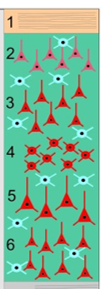
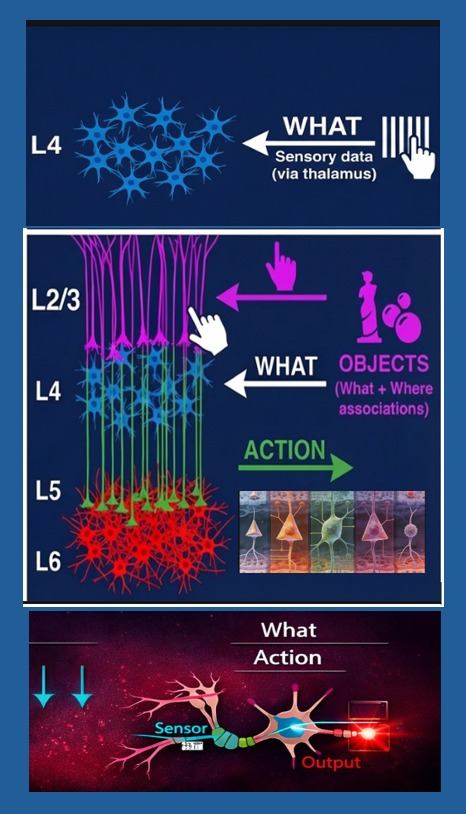
The neocortex is arranged in layers, each with its own population, style of connectivity, and physiological role. Yet these layers do not stand apart. They form a vertical conversation. Signals arrive, spread, are interpreted, amplified, inhibited, and returned outward. Thus, the cortex becomes not a flat surface, but a depth-structured field of organized processing.
Foundations with micro pyramids
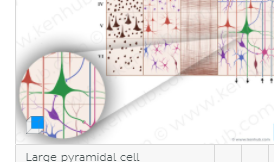
Within this layered design, pyramidal cells hold special significance. Their bodies, dendrites, and long vertical reach allow them to connect distant levels of cortical life. Small pyramidal arrangements, repeated in disciplined patterns, may be seen as micro-foundations of larger cortical function. From these subtle structural repetitions, the possibility of integration emerges.
The living neural forest
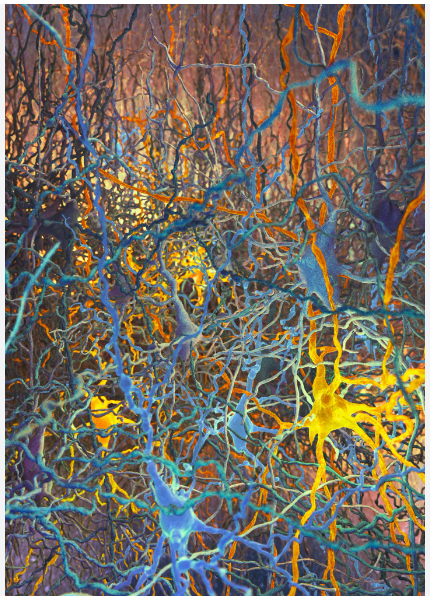
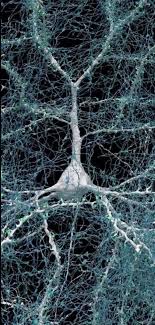
When we look closer, the cortex resembles a dense forest, crowded with branching forms, intersections, and hidden pathways. No single neuron carries the whole story. Meaning emerges from relations, recurrences, and layered loops. The beauty of this tissue lies not only in its complexity, but in the disciplined repetition of complexity.
Macrocolumn and microcircuit
A macrocolumn may be understood as a larger orchestration built from many smaller repeating units. Minicolumns, local circuits, and pyramidal networks together create an architecture that is both distributed and coherent. Such repetition gives stability. Such variation gives richness. In this union of order and flexibility, cortical intelligence may find its physical basis.
Thalamocortical loops and the potential of awareness
Recent work done in the field of neurosciences have decoded aptly the ways, as how complex circuitry in neocortex columns differentiate allocentric and egocentric informations. Cutting edge research labs now suggests the possible format, and sequentially compiled steps of content + context of inputs. Memory (past) is always the main background as overarching manifold, where sensory relay information (present) and brain's predictive capacity (future), are always pot-boiling to emerge unified.
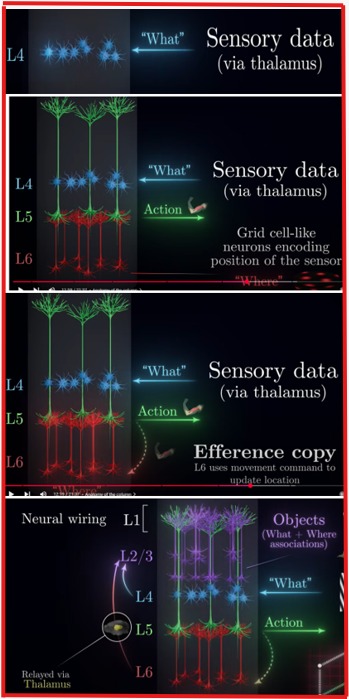
Thalamocortical circuits appear to keep the fifth cortical pyramidal layer in a living loop, through spontaneous intermittent bursting. Such recurrent activity may hold the potential of awareness. What matters here is not merely signal transmission, but the maintenance of a dynamic inner readiness, a state in which cortical structure remains poised for integration, selection, and experience.
Every microcolumn seems to possess, within its own structure, a remarkable capacity to integrate spatial and temporal context. In that sense, a single microcolumn may be seen as an advanced functional unit, a miniaturised and compact analogue of certain hippocampal and entorhinal functions, including memory analysis, storage, recall, and valence evaluation.
This is the beauty of evolution, that after millennia over millennia of permutations and improvement, it came out with neocortical columns, and the trick was mostly advanced circuitry using the same old cortical layers, sandwiched in innovative folds, to create the MAGIC of human intelligence, which has further created the emergence of the AGI (Generative Intelligence) revolution that we have today.