Windows into Consciousness
The LIVE Online Dream Script
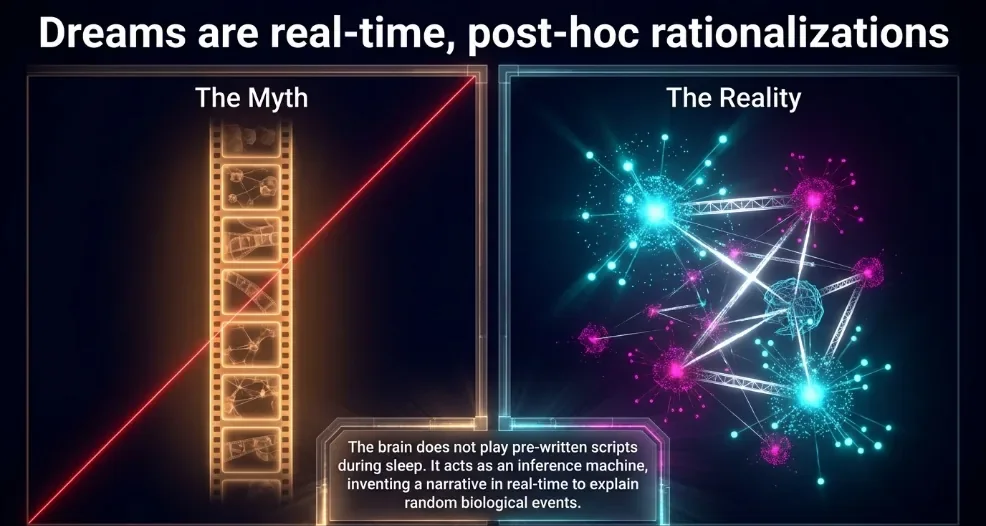
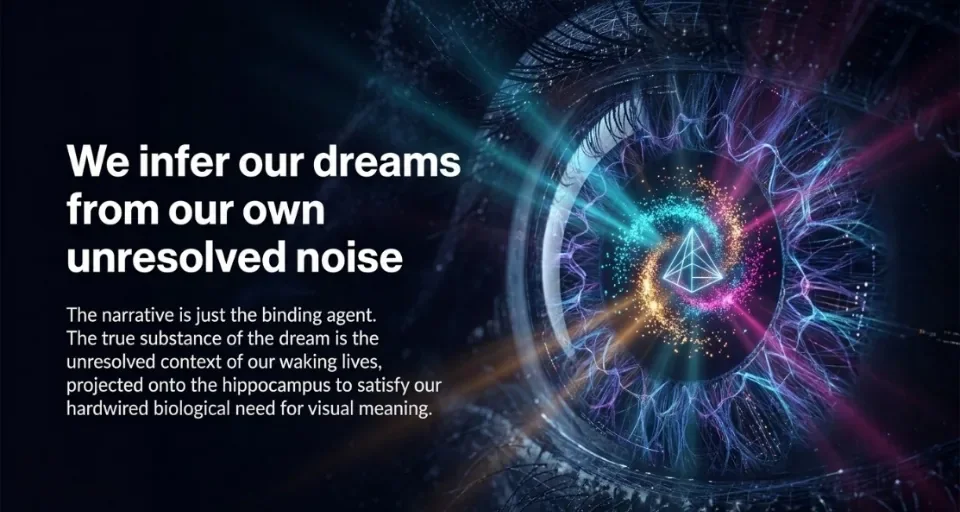
"Online Live: Dream Script in the Making" describes the dreaming brain not as a narrator reading a pre-written story, but as a real-time "live stream" where a narrative is synthesized to explain a sequence of discrete motor acts. This process functions through a three-tiered system where motor commitments drive the story, rather than the story driving the dream.
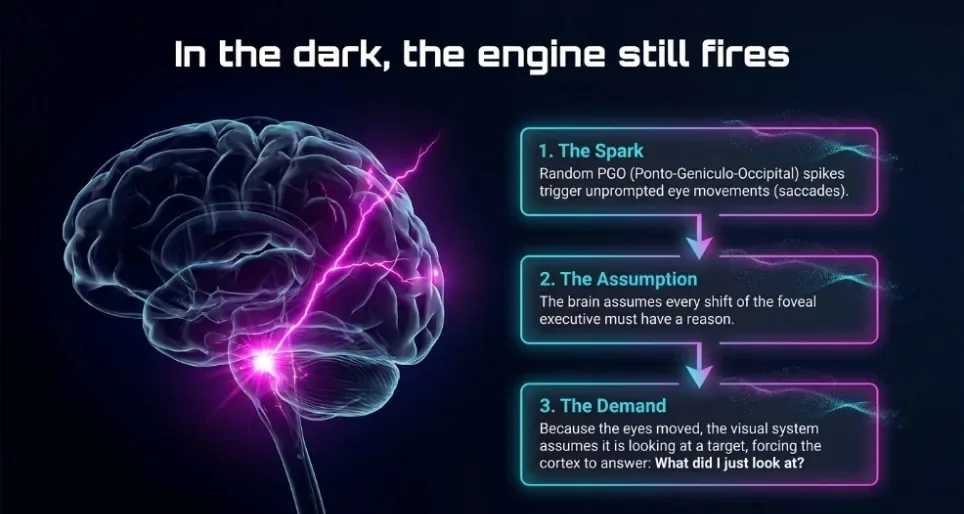
Tier 1: The Spark (The Trigger)
The "live stream" begins in the Pons with PGO (Pontine-Geniculo-Occipital) spikes. These spikes act as the "starting gun" or internal activation pulses that force the oculomotor system to shift. They hit the Lateral Geniculate Nucleus and Occipital Cortex to simulate a visual "event" without external light. At this stage, there is no story—only the "engine" firing to trigger eye movements.
Tier 2: The Raw Material (The Context)
This tier consists of the "noisy votes"—a chaotic swirl of unresolved emotional memories, "temporary memory parts," and potential actions known as affordances.
Emotional Valence: Unsettled emotions or threats act as high-priority votes in the competition to determine what the brain will "look at" next.
Relevance Competition: This internal data competes for the fovea's attention, essentially looking for a "stage" to be processed.
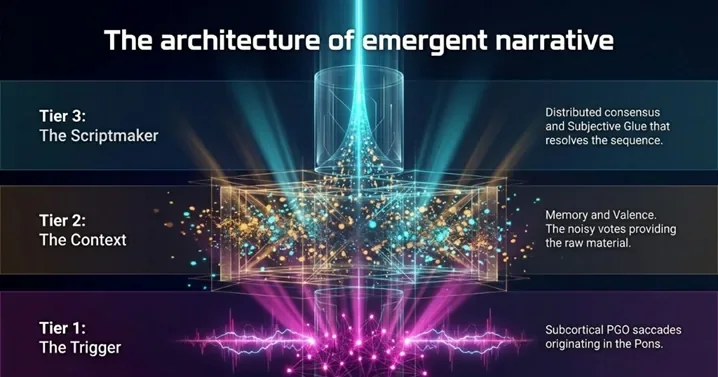
Tier 3: The Scriptmaker (Distributed Consensus)
The actual "script" is the real-time resolution of the competition between these noisy votes. This involves several key mechanisms:
The Foveal Bottleneck: Because the brain can only focus on one simulated target at a time, it must reach a "distributed consensus" on where to look.
The Subjective Glue: When a PGO spike triggers a saccade (eye movement) from one simulated target to another (e.g., from a "lion" to a "door"), the brain's neural architecture—which is hardwired to assume spatial persistence—must explain the jump.
Retroactive Synthesis: To bridge the gap between these random targets, the cortex immediately invents a narrative—such as "running away"—to make the motor commitment feel intentional and coherent.
The Spatial Stage: The Hippocampus
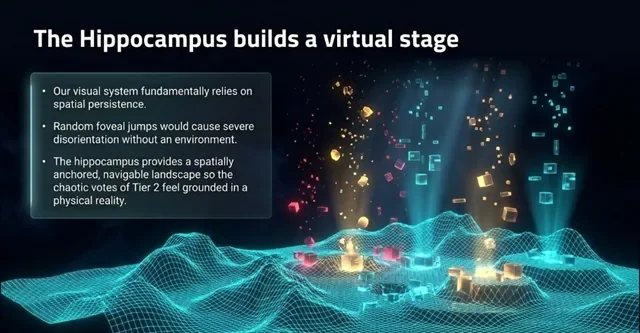
For this "live" production to feel real, it requires a stable environment. The hippocampus acts as the "stage" by providing a virtual landscape.
Spatiotemporal Mapping: It replays sequences of "place cells" to create a persistent, navigable world.
Spatial Anchoring: This ensures that when the eyes jump between targets, the brain "believes" it is looking at different parts of the same persistent space rather than meaningless jumps in a void.
In summary, the dream narrative is the "subjective glue" applied post-hoc to a sequence of motor commitments; your brain is an inference machine that invents a story to justify where your eyes have already decided to go.