A neural score in five movements
Thalamic Rhapsody
on oscillation · computation · memory · consciousness
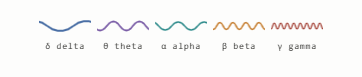
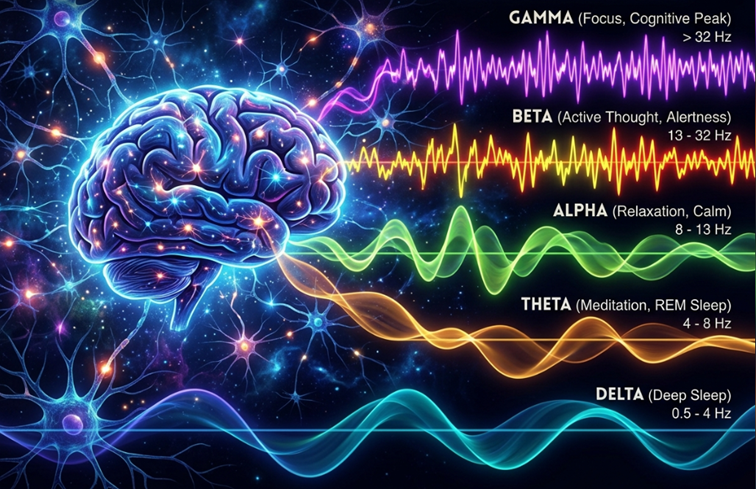
δ delta θ theta α alpha β beta γ gamma
 I.The Conductor Takes Position
0.5 – 80 Hz
At the center of all things neural,
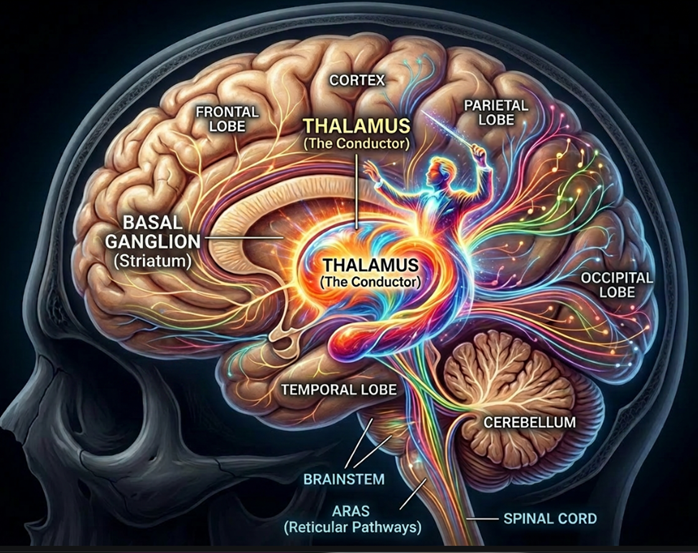
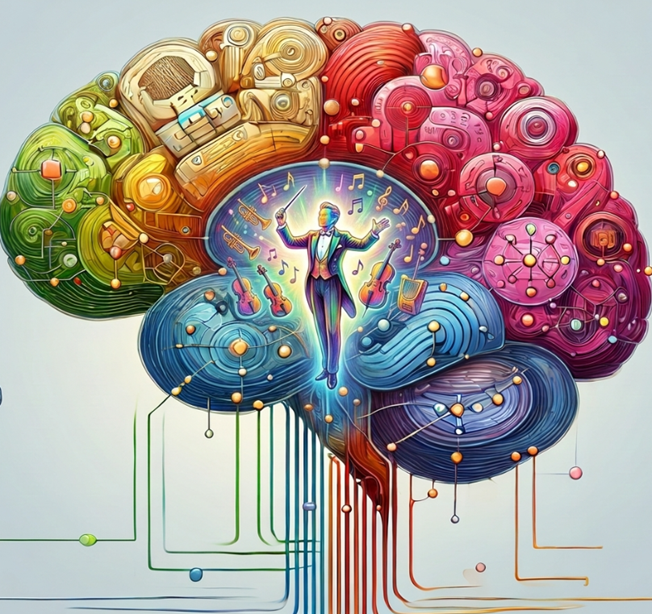
the thalamus does not compose — it conducts.
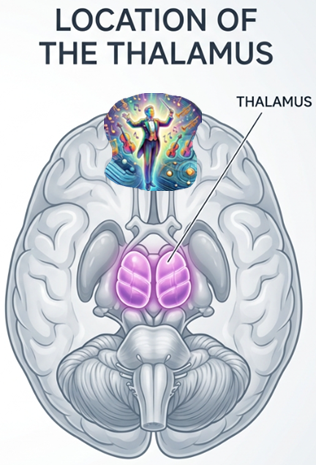
Two walnut-sized masses of relay nuclei,
flanking the third ventricle,
they receive every signal the world sends and decide,
with sovereign timing,
which instruments shall play.
No sensory message reaches the cortex
without the thalamus lifting its baton.
No attentional shift occurs without its tempo marking.
It is not passive. It is not a relay box.
It is the score itself,
written in oscillating ink,
re-written every 12 milliseconds,
over and over, across a lifetime.
attractor · 0.5–4 Hz
Deep in slow-wave sleep, the thalamus retreats into itself —
bursting, spinning,
broadcasting the slowest tide across every cortical shore.
This is the foundation register : delta ,
the double bass of the neural orchestra,
reverberating below the threshold of awareness,
coupling to the wakefulness from ARAS in brainstem,
stitching the memories of the day into permanent form.
II.Generating the Score
θ 4–8 Hz
The thalamus does not receive a finished score.
It generates one, moment by moment,
from chaos and constraint.
Its reticular nucleus —
a thin shell of inhibitory neurons
wrapping the whole structure like a resonant membrane —
fires rhythmic bursts that rebound from relay nuclei
back to cortex and back again, spontaneously
producing the spindle oscillations of sleep,
the alpha idling of quiet wakefulness,
the theta scrolls of memory encoding.
These are not random.
They are the thalamus computing, in real-time,
which combinations of frequency and phase
will serve the organism's present need.
attractor · 4–8 Hz
Theta — the viola section,
mournful and searching — emerges
when the hippocampus demands the thalamus's attention.
Navigation, episodic encoding,
the threading of "now" into "then."
Every journey taken, every face stored, every regret archived:
theta is the carrier wave of becoming.
III.The Combinatorial Engine
α 8–12 Hz
Consider the full orchestral palette available at any waking moment:
The thalamus does not play these one at a time.
It computes their combinations —
coupling delta with theta for dreaming,
nesting gamma inside alpha for focused inhibition,
threading beta through gamma for perceptual awareness.
The space of possible pairings
and phase relationships across five bands
and dozens of nuclei yields
a combinatorial universe
vast enough to encode
every state a human mind can inhabit.
IV.The Orchestra at Full Voiceβ · γ
When all sections play together —
when the thalamus dispatches gamma
to bind the visual cortex with the auditory,
while theta carries the emotional charge
from amygdala to prefrontal lobe,
while beta sustains the motor prediction
of a next word, next step, next breath —
the result is not mere information processing.
The result is experience.
The result is you.
attractor · affect & intelligence
Intelligence is not the loudness of gamma.
It is the elegance of the baton —
the thalamus knowing when to dampen the horns,
when to let the strings carry alone,
when to call the full orchestra to a single crashing chord of insight.
Emotion is the tempo marking:
allegro furioso… in fear,
adagio … in grief,
con brio… in joy.
Consciousness is the moment
the musicians forget they are playing
from parts and realize,
briefly,
they are the music.
attractor · consciousness
The gamma flash —
40 to 80 Hz, the fastest binding the thalamus authorizes —
is consciousness's ignition.
When a sensory signal crosses the threshold the thalamus sets,
gamma floods the corticothalamic loop,
binding distributed representations
into a single moment of knowing.
Without the thalamus setting that threshold,
the cortex fires in fragments.
The lights are on; no one is home.
The thalamus is the one who turns them up.
V.Scripted as Attractors — A Lifetime
memory · time
Every neural orchestra performance leaves a trace.
Each oscillatory pattern that has synchronized —
each combination
of delta and gamma that encoded a childhood morning,
each theta that threaded a first love into long-term store,
each alpha that silently held a grief —
carves a basin of attraction into the thalamocortical landscape.
These basins are not static memories.
They are gravitational fields: the Attractors
the next time conditions resemble what they once were,
the thalamus finds the familiar rhythm,
the cortex tilts toward the old valley,
and the past is not recalled —
it is re-enacted.
attractor · distributed memory
The smell of rain on hot stone.
A chord from a song you have not heard in thirty years.
The particular quality of light on a Sunday afternoon.
These are not stored as files.
They are attractors distributed across the thalamocortical network —
strange cortical, attractors,fractals,and toroids or so,
in the dynamical-systems sense,
drawing nearby trajectories into their basin with gentle, irresistible pull.
The thalamus is the custodian of these basins,
refreshing their topography every night in delta sleep,
every afternoon in alpha,
every dreaming arc of theta.
Across a human lifetime —
roughly seventy years of orchestral performance,
some 2.2 billion seconds of oscillation —
the thalamus never plays the same phrase twice,
yet never loses the theme.
The rhapsody remains recognizably itself:
the same temperament in the tempo markings,
the same harmonic preferences,
the same tendency to resolve to a particular key
when the music is left alone long enough.
This is personality. This is self.
Written in frequency.
Conducted by a structure the size of two walnuts.
Revised, nightly, in delta.
Performed, continuously,
until the music stops.
the last movement
"The thalamus does not know it is conducting.
It has no audience…. There is no hall.
There is only the oscillation:
the perpetual generation of the score
from which consciousness reads itself into being,
moment by moment,
attractor by attractor,
wave by wave — a rhapsody that is,
at once, the composer, the musician, the music,
and the only listener who has ever truly heard it."
thalamic oscillation cycles in an 80-year life: ~80,030,073,600